Lăpușna Royal Hunting Lodge
Castelul de vânătoare Lăpușna
sat Lăpușna; comuna Ibănești, Mureș · f. n.
Press reports it is open to tourists; official opening hours are not known
Summary
A timber royal hunting lodge in the Gurghiu Mountains at about 815 m, built in the 1920s for King Ferdinand I near Lăpușna village (Ibănești commune, Mureș County). Later used by Carol II and by communist leaders, it is run today by a private company and kept as a tourist site, while a restitution claim by Prince Paul of Romania has been in the courts.
Legal status
Passed to the state in 1948 (a historian argues the 1940 sequestration and Hungarian administration 1940-44 preclude 1948 nationalisation); privatised under Law 15/1990; restitution claim by Prince Paul filed 2006, rejected 2012, retrial ordered on appeal (status as of the 2014 article, updated 2024) ↗
History
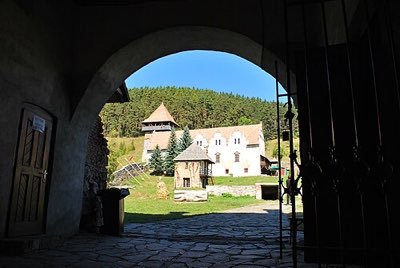
King Ferdinand I bought about 4 ha of forest and pasture here in 1923, and building started in 1925-1926 on a design by Count Lecomte du Noüy. After du Noüy's death the Czech architect Karel Zdeněk Líman continued the work until he died in 1929, and the lodge was finished and decorated in 1933 with craftsmen from Reghin. The main timber building has six wings with 23 rooms, a stone foundation, Vienna terracotta stoves and stained glass made in Munich. Ferdinand left it to Prince Nicolae, who was made to donate it to his brother Carol II in 1939. In communist times it hosted hunting visits by Khrushchev, Zhivkov and Tito. Until 1989 it was run by the Mureș county tourism office; under Law 15/1990 it passed to a Târgu Mureș company, S.C. Grand S.A. A restitution claim under Law 10/2001 was filed in 2006 by Prince Paul; the first-instance court rejected it in 2012, a retrial was ordered on appeal, and press reports say investment is on hold until the case ends.
Transactions & prices
Sources & links
Found a mistake, or know more about this building? Write to us at contact@conace.eu.